Nano Today: World-First Needle-Free Injection of COVID-19 mRNA-LNP Vaccines Shows Significantly Enhanced Immunogenicity and Stability
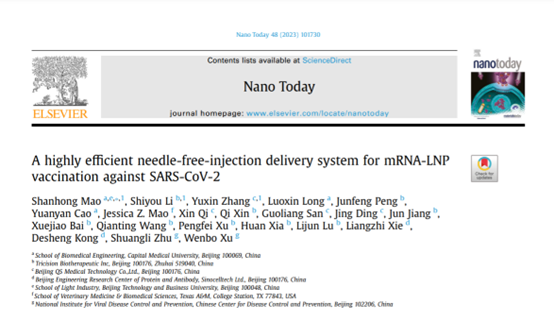
A multi-institutional study published
in Nano Today, titled "A Highly Efficient
Needle-Free-Injection Delivery System for mRNA-LNP Vaccination against
SARS-CoV-2," was conducted by researchers from Capital Medical
University's School of Biomedical Engineering, tricision, Beijing RapidShot
Medical Technology, SinoCellTech, Beijing Technology and Business University,
Texas A&M University, and the Chinese CDC's National Institute for Viral
Disease Control and Prevention. The study was led by Professor Mao
Shanhong of Capital Medical University, with Dr. Li Shiyou (Co-founder/CTO
of tricision) and Zhang Yuxin (founder of RapidShot) as
co-first authors.
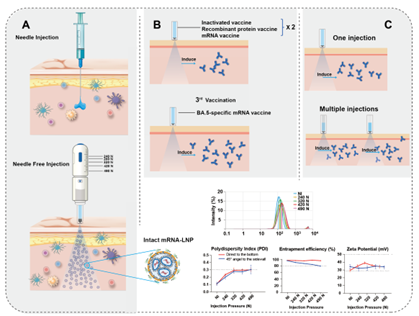
This is the world's first report of Needle-Free Injection (NFI) for COVID-19 mRNA-LNP vaccination in animal models. The study introduced an NFI device combined with a SARS-CoV-2 spike protein mRNA-LNP vaccine, establishing a novel delivery system. Compared to conventional Needle Injection (NI) , NFI significantly enhanced vaccine immunogenicity, while the mRNA-LNP formulation also demonstrated excellent stability and ease of storage.
Significantly Improved Vaccine Stability
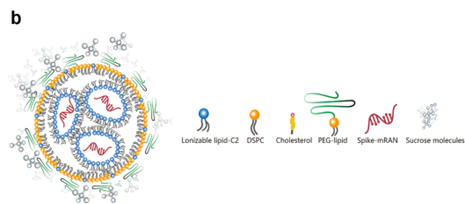
The mRNA-LNP vaccine formulation, developed by tricision with support from the Beijing Municipal Science and Technology Commission's "Key Project for Pharmaceutical Innovative Varieties and Platform Cultivation" (Grant No. Z211100002521025), had achieved pilot-scale production capability. The formulation uses tricision's proprietary ionizable cationic lipid C2, along with DSPC, cholesterol, and PEG-lipids to encapsulate mRNA, with sucrose as an antioxidant.
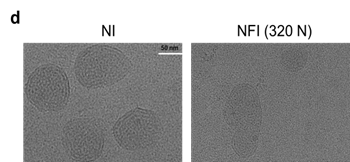
The vaccine was specifically designed to overcome the technical challenge of high pressure damaging LNP structure, enabling NFI compatibility. Post-injection, physicochemical parameters (particle size, PDI, encapsulation efficiency, zeta potential) remained within normal ranges, and cryo-EM imaging showed no structural damage.
The lyophilized mRNA-LNP vaccine demonstrated at least 6 months of stability at 2–4°C, highlighting its practical advantages over conventional vaccines.
Significantly Enhanced Immunogenicity
To evaluate immunogenicity, the team
immunized New Zealand rabbits with two mRNA-LNP vaccine doses. NFI-administered
animals showed significantly higher neutralizing antibody titers against
Omicron BA.5 live virus compared to the NI group. A third dose with BA.5-LNP
vaccine boosted titers to plateau levels in both groups, and ACE2 competition
inhibition assays showed 3.70-fold increases in BA.5-specific
neutralizing antibodies post-third dose. Subcutaneous NFI induced higher
neutralizing titers than intramuscular injection. The same immunogenicity
advantage was observed with inactivated and recombinant protein vaccines, and
the BA.5-LNP booster enhanced BA.5-specific neutralizing antibodies across all
experimental groups.
The authors concluded:
- NFI significantly enhances immunogenicity for mRNA-LNP,
inactivated, and recombinant protein vaccines.
- Omicron BA.5-specific mRNA-LNP vaccines are effective boosters
against Omicron subvariants, regardless of prior vaccination type.
- Dividing a single vaccine dose into multiple aliquots for NFI
at different sites further enhances efficacy.
- The optimized NFI system is compatible with mRNA-LNP stability,
opening doors for other vaccine and drug applications.
This study provides a new approach and
solution for COVID-19 vaccine development and deployment, particularly for
elderly and vulnerable populations.