Disguise and Deception: Why Is Chemical Modification Essential for mRNA Drug Development?

On June 16, 2021, CureVac announced that
its COVID-19 vaccine candidate had shown only 47% efficacy in
a Phase III interim analysis—below the ≥50% threshold for approval. This was a
significant setback, raising questions among researchers.
While CureVac attributed the result to the
rapidly evolving virus, some researchers suspected the vaccine design. Dr. Drew
Weissman of the University of Pennsylvania noted that the vaccine used unmodified
mRNA—which, when injected, triggers interferon production. While
interferons signal immune activation, they can also suppress T helper cell
production, which in turn guides B cells to produce antibodies.
This case highlights the critical
importance of molecular design in mRNA drug development to
address stability, translation efficiency, and immunogenicity—ensuring safety
and efficacy. These goals are achieved through various chemical
modifications: 5' capping, 3' poly(A) tailing,
and nucleotide modification.
Mature eukaryotic mRNA contains several key structural elements: 5' cap, 5' UTR, open reading frame (ORF) , 3' UTR, and poly(A) tail. In vitro-synthesized mRNA mimics natural mRNA structure.
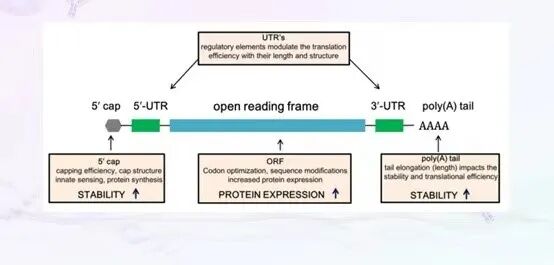
The 5' cap (7-methylguanosine,
m7G) regulates mRNA maturation, facilitates nuclear export, protects against
exonuclease degradation, recruits ribosomes via translation initiation factors,
and modulates translation efficiency. Poly(A) tailing improves
stability by recruiting poly(A)-binding proteins, slowing degradation and
extending half-life—and plays a crucial role in translation efficiency through
interaction with the translation machinery.
The mRNA "body" is composed of
four basic nucleotides: G, A, C, and U. Modification of the "body"
through incorporation of chemically modified nucleotides significantly enhances
translation efficiency, extends half-life, and reduces immunogenicity. The most
prominent modification is pseudouridylation—where uridine (U) is
converted to pseudouridine (Ψ) catalyzed by pseudouridine synthase.
In 2005, Katalin Karikó and colleagues
reported that incorporating pseudouridine into RNA reduced immunogenicity in a
dose-dependent manner. In 2008, they showed that complete replacement of
uridine with pseudouridine dramatically reduced immunogenicity, increased
stability, and enhanced translation. The two approved mRNA COVID-19 vaccines—mRNA-1273
(Moderna) and BNT162b2 (Pfizer–BioNTech) —both use
N1-methylpseudouridine triphosphate (m1ψTP) instead of uridine triphosphate
(UTP). As suggested above, CureVac's failure may have been due to its use of
unmodified nucleotides.