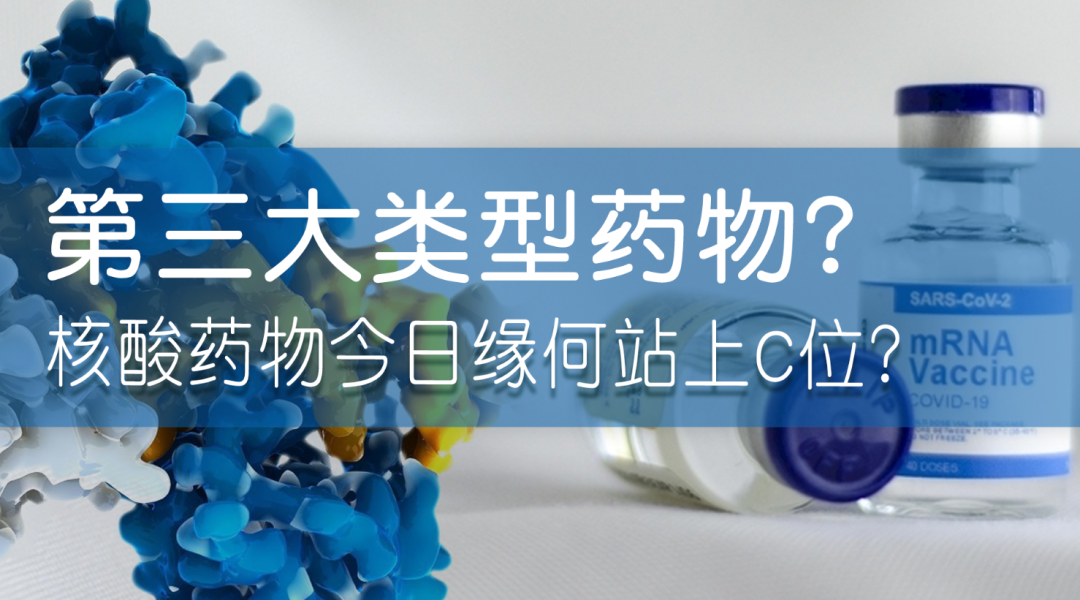
The Third Major Drug Class? Why Nucleic Acid Drugs Are Taking Center Stage?
In 1897, Felix Hoffmann synthesized
acetylsalicylic acid—the world's first synthetic drug, aspirin. In 1975,
Milstein and Kohler developed hybridoma technology, giving birth to monoclonal
antibodies. In 1978, Paul Zamecnik demonstrated that synthetic antisense
oligonucleotides could inhibit Rous sarcoma, launching nucleic acid drug
research. Over 125, 77, and 44 years respectively, different drug classes have
dominated different eras.
Nucleic acids—polymers of nucleotides
including DNA and RNA—are fundamental to life.
Nucleic acid drugs, composed of functional oligomeric RNA or DNA, directly act
on pathogenic target genes or mRNAs to modulate disease at the genetic level.
Traditional small-molecule and antibody
drugs bind to target proteins, limited by the druggability of the protein
target. The human genome encodes approximately 20,000 proteins—only about 3,000
are considered druggable, and only ~700 have corresponding approved drugs.
Antibodies primarily target extracellular or membrane-bound proteins. In
contrast, nucleic acid drugs are gene-targeted therapeutics that
regulate gene expression at the source—offering both symptomatic and
root-cause treatment. They can target molecules inaccessible to traditional
drugs (e.g., mRNA, miRNA), offering breakthrough potential for hard-to-treat
diseases including genetic disorders, cancer, and emerging infections.
Nucleic acid drug development is also
faster and simpler. Small-molecule discovery involves screening compounds
against target proteins—a lengthy process. Nucleic acid drugs are designed
based on base-pairing complementarity; any gene sequence could theoretically
become a target, requiring only rearrangement of A, G, C, T(U) bases.
Despite early challenges—instability,
immunogenicity, poor cellular uptake, and endosomal escape—key technological
breakthroughs have resolved these issues. Since the first nucleic acid drug
(fomivirsen sodium) in 1998, over 10 nucleic acid drugs have been approved,
including two mRNA COVID-19 vaccines, with hundreds more in clinical trials.
With advantages of high
specificity, high efficiency, long duration, and low toxicity, nucleic acid
drugs—including ASO, siRNA, miRNA, saRNA, mRNA, RNA aptamers, ribozymes, and
antibody-nucleic acid conjugates—are poised to become the third major
drug class, following small molecules and antibodies. Billions of years
ago, nucleic acids gave rise to life. Today, as humanity faces major diseases,
nucleic acid drugs are rising to the challenge—opening new frontiers in drug
discovery and enabling gene therapy and personalized medicine.