
From Treatment to Prevention: How Far Are Cancer Vaccines?
Abstract: The Next Frontier of Cancer
Vaccines
"Three transformative
events have taken place in the cancer‑vaccine community over the
past 20‑plus days," remarked Professor Youwen
He, tenured full Professor in the Department of Immunology at Duke University
Medical Center, specially appointed expert for the U.S. National Vaccine
Program, and Chairman of tricision Biotherapeutics, in a recent interview
with Tongxieyi.
First, on August 19, Merck
and Moderna jointly announced that their personalized mRNA neoantigen therapy
intismeran autogene (V940/mRNA‑4157) combined with Keytruda (pembrolizumab)
met the primary endpoint in the Phase III INTerpath‑001 trial.
Also centered on mRNA and
neoantigens, two weeks later, another major mRNA player BioNTech reported
negative results in its Phase II adjuvant trial for its personalized mRNA
cancer vaccine autogene cevumeran in post‑surgical colorectal cancer.
The third development is
more likely to go unnoticed: on August 19, the U.S. Food and Drug
Administration (FDA) released Potency Assessment of Active Immunotherapy
Products Draft Guidance for Industry. "This landmark guidance is
specifically tailored for personalized therapeutics."
In Professor He's view,
taken together, these developments deliver a core insight: personalized
therapeutics will become a central direction for treating major diseases.
"The one‑size‑fits‑all treatment model cannot
cope with the high heterogeneity of cancer. Cancer is not a single disease but
a collection of thousands of disease clones within a single patient. Therefore,
treatment must be customized for each individual patient and adjusted
dynamically as the disease evolves."
A scientist with 40 years of
immunology research experience, Professor He has witnessed the full evolution
of cancer immunotherapy. In this conversation with Tongxieyi, he examines the
prerequisites for therapeutic cancer vaccines, the strategic value of
preventive cancer vaccines, and future directions for paradigm shifts in
oncology treatment from a macro perspective.
To draw an analogy, cancer
vaccines function like the ignition of a car: ignition is required to start the
car, yet ignition alone is insufficient. You also need to release the brake and
step on the accelerator. "Releasing the brake corresponds to anti‑PD‑1 therapies, namely immune
checkpoint inhibitors; stepping on the accelerator refers to cytokines such as
IL‑12, IL‑2 and IL‑15."

Photo: Dr. Cheng and Professor Youwen He at BIOHK 2026
TONACEA
1、What Do One Success and One Failure Reveal?
Clinical
research into cancer vaccines is a history written in failures. More than three
decades ago, academia and industry worldwide began betting on this track —
using vaccines to train the immune system to recognize and attack tumors.
The
concept is compelling, yet real‑world
outcomes have been harsh.
In
2010, Provenge (sipuleucel‑T),
developed by Dendreon, gained FDA approval, becoming the world's first
therapeutic cancer vaccine and the only approved one for more than a decade.
It
marked a milestone, yet stood almost as an isolated case.
In
its Phase III trial, Provenge extended the median overall survival of patients
with advanced prostate cancer by merely 4.1 months (25.8 months versus 21.7
months). Its manufacturing workflow was extremely complex; driven by high costs
and modest efficacy, Dendreon ultimately filed for bankruptcy.
Subsequently,
more than 30 cancer vaccine candidates failed in Phase III clinical trials, and
the FDA did not grant approval for any further therapeutic cancer vaccines for
years.
Hope
resurfaced in August 2026. The mRNA cancer vaccine intismeran combined with
Keytruda demonstrated statistically significant and clinically meaningful
improvements in both recurrence‑free survival (RFS) and
distant metastasis‑free
survival (DMFS) as adjuvant therapy for patients with completely resected Stage
IIB‑IV
melanoma.
Professor
Youwen He notes that although full raw clinical data from Moderna have not yet
been published, he remains optimistic, because this vaccine has identified the
scientifically correct direction.
First,
it selected the appropriate disease stage.
Beyond tumor type, disease stage matters critically. Intismeran
intervenes when tumor burden is at its lowest — after complete surgical
resection, in the relapse‑prevention
setting. At this point, the immune system remains fully capable of being
activated, and residual minimal residual disease (MRD) represents the optimal
window for vaccine action.
"Physical
interventions such as radiotherapy, surgery and precision radiotherapy can
control visible tumors. What truly concerns clinicians are invisible tumors
undetectable by imaging, which can metastasize distantly and spread like
dandelion seeds. This is where vaccines can play a role. Cancer vaccines must
be deployed in the right clinical setting," Professor He elaborated.
Second,
it uses combination therapy with PD‑1
blockade. Professor He offered a vivid analogy:
"A cancer vaccine is a car's ignition. You have to ignite the engine
before the car moves, but ignition alone will not suffice. You also need to
release the brake — releasing the PD‑1‑imposed brake on T
cells."
By
contrast, BioNTech's colorectal cancer trial stumbled on exactly this point.
The BNT122‑01
trial evaluated autogene cevumeran as monotherapy, without combining it with
immune checkpoint inhibitors. Without the "brake‑release" effect
of PD‑1
inhibitors, vaccine‑activated
T cells are rapidly suppressed by the tumor microenvironment.
Professor
He states plainly that BioNTech's misstep lay in deploying the vaccine as
monotherapy, reflecting an incomplete understanding of how the vaccine works.
The trial termination merely confirms that the underlying scientific rationale
was flawed from the outset.
"One
failure and one success tell us we must select the right tumor type, disease
stage and combination platform. mRNA is a promising technical modality, yet it
must be deployed correctly. These serve both as lessons learned and cautionary
take‑homes,"
Professor He summarized.
For
the Moderna case, Professor He regards it also as a victory belonging to the AI
era. Intismeran can encode up to 34
neoantigens.
"Tumors
harbor numerous mutations; we only select a small subset of those mutations to
construct neoantigens today. This work would be impossible without AI. For
example, full exome sequencing analysis once took our team one week; now it can
be completed within 10 minutes. The difference is enormous. Cancer vaccines
could only emerge in the present era."
Professor
He adds a word of caution: "Even though intismeran encodes 34 algorithm‑selected neoantigens,
likely only one or two of them are functionally active. Even the developer
cannot definitively identify which ones, pointing to the immense complexity of
the underlying biological processes."
TONACEA
2、The Promise of Personalized Therapeutics
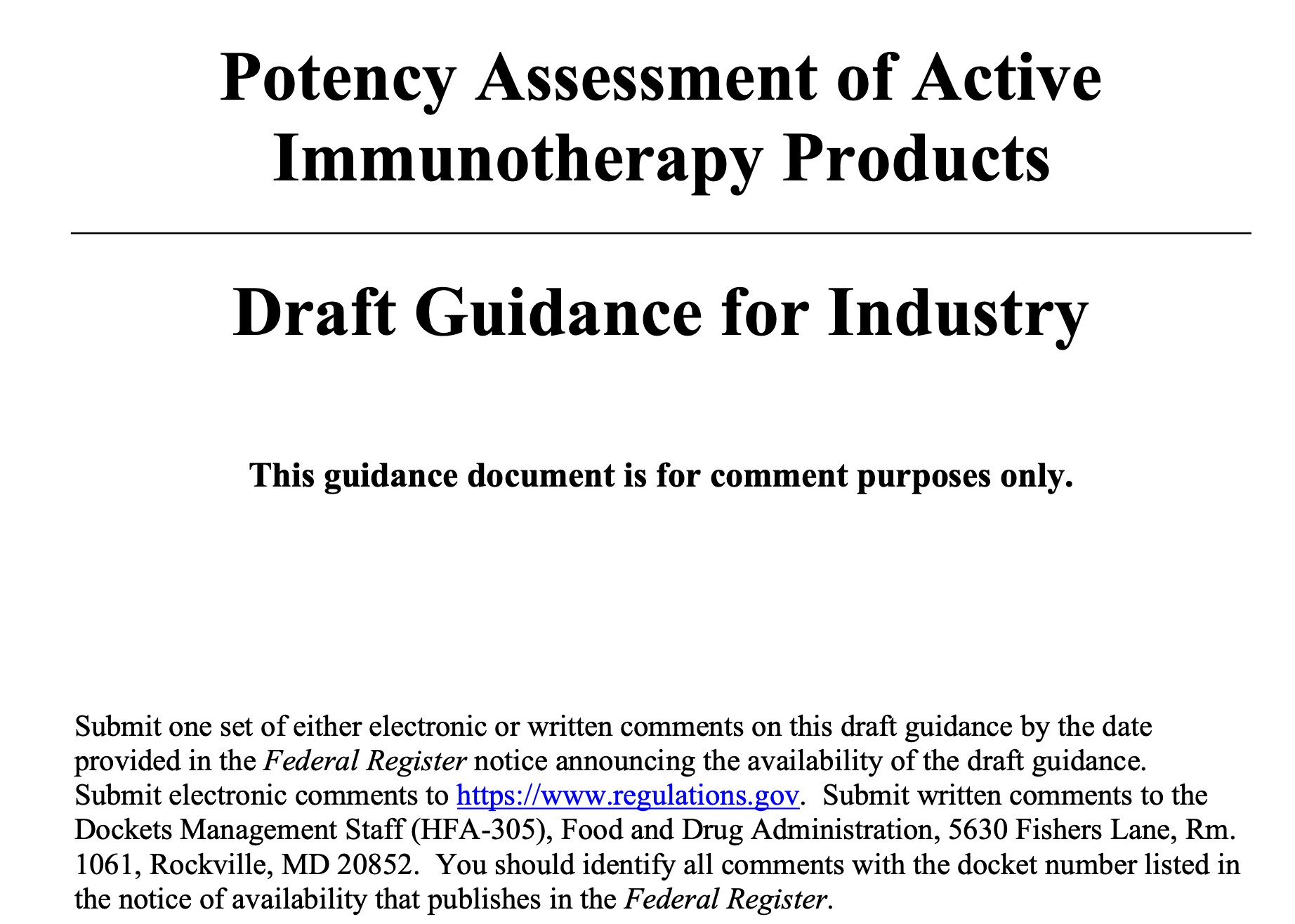
Released by the FDA in
August 2026, this draft guidance provides systematic recommendations for
development, validation and quality‑control strategies for
potency testing of Active Immunotherapy Products (ACTIMPs).
Traditional
drug‑regulation
frameworks are built around the concept of potency. For pharmaceuticals ranging
from aspirin to Keytruda, the active ingredient and manufacturing process are
fixed, and potency testing is performed for every batch before release to
guarantee consistent quality across batches.
Personalized
mRNA neoantigen vaccines upend this logic entirely. Each patient's vaccine is
individually designed according to that patient's unique tumor mutational
landscape; every single vaccine product is essentially one of a kind. In the
precision‑medicine
era, how should potency be evaluated for personalized therapeutics?
Professor
He points out that this FDA draft guidance breaks new ground via two core
principles:
First,
potency is no longer assessed only through testing of the final finished
product. Instead, evaluation is performed based on Critical Quality
Attributes (CQA). Regulators assess whether bioinformatic analysis and
biomanufacturing workflows are qualified, stable and well‑controlled.
Regulatory oversight shifts from testing each individual vaccine lot to
validating the entire production system, representing major regulatory progress
for personalized therapeutics.
Second,
personalized products are no longer restricted to manufacturing within a single
fixed facility. Historically, FDA‑approved drugs had to
be manufactured at predefined sites. This guidance explicitly recognizes that
multiple manufacturing locations are permissible — a development critical for
the commercialization of personalized vaccines.
Professor
He holds that personalized therapeutics will become a core pillar for treating
major diseases. "More than a decade ago I treated cancer patients in
clinical practice and kept arguing that our existing treatments are far too
outdated. How can one‑size‑fits‑all regimens work for
such complex diseases as cancer? We need patient‑specific treatment
strategies, and those strategies must be adjusted dynamically over time."
Professor
He shared a striking real‑world
example: glioblastoma, known as the "king of cancers." Tumor tissue
is sequenced at initial diagnosis and again upon disease recurrence. The
overlap in detected gene mutations between the two time points may be as low as
3%. "In practical terms, recurrent disease becomes an almost entirely
distinct illness. Treatment eliminates mutation‑sensitive tumor
clones, leaving behind resistant clones refractory to chemotherapy and
radiotherapy."
Professor
He emphasizes a second core principle in oncology: only the immune system
can achieve tumor control. All other therapeutic modalities must serve to boost
anti‑tumor
immunity.
"It
resembles the Terracotta Army: each warrior carries different weaponry. Our T
lymphocytes operate by the same principle, targeting different mutations. Only
by mobilizing the immune system can we achieve tumor control."
This
clarifies the logic behind personalized tumor vaccines: they identify unique
mutations from a patient's tumor and turn them into targets recognizable by the
immune system so that T cells can recognize and attack tumor cells. Since
mutation profiles differ across individuals, therapies must be customized per
patient.
Nevertheless,
industrial‑scale
personalized therapeutics bring complex challenges. If each patient represents
an independent manufacturing batch, accessibility and cost emerge as major
bottlenecks. Professor He outlines three potential pathways to address these
challenges.
First,
bypass antigen‑specific
components via innate immune activation.
mRNA itself acts as an innate immune activator triggering Type I interferon
pathway activation. Type I interferons (α, β) are already FDA‑approved for oncology
indications, creating opportunities for universal therapeutic candidates.
Second,
even though patient‑specific
regimens represent the future, shared targets exist among tumor‑associated
antigens and neoantigens. For instance, KRAS
mutations occur across multiple tumor types and can be exploited for off‑the‑shelf vaccine
candidates.
Third,
AI‑driven
fully automated manufacturing facilities will greatly reduce costs and shorten
turnaround timelines. This is part of the intent
behind the FDA guidance: in the future, on‑site devices near
patients' hospital beds will manufacture personalized vaccines and therapeutics
in real time. Instead of centralized production plus logistics transport,
manufacturing occurs locally on demand. This unlocks tremendous potential for
pharmaceutical innovation while clearing the path for regulatory adaptation.
TONACEA
3、The "Crown Jewel" Atop the Pyramid
Compared with therapeutic cancer vaccines, Professor He is more optimistic about preventive cancer vaccines, corresponding to vaccines in the conventional public understanding.
Renowned medical scientist Dr. Eric Topol, Founder and Director of the Scripps Research Translational Institute, published an immunotherapy pyramid. Immune checkpoint inhibitors sit at the base, followed upward by oncolytic viruses, CAR‑T and other modalities. Positioned at the very apex of the pyramid are interceptive vaccines — preventive vaccines that intercept cancer onset.
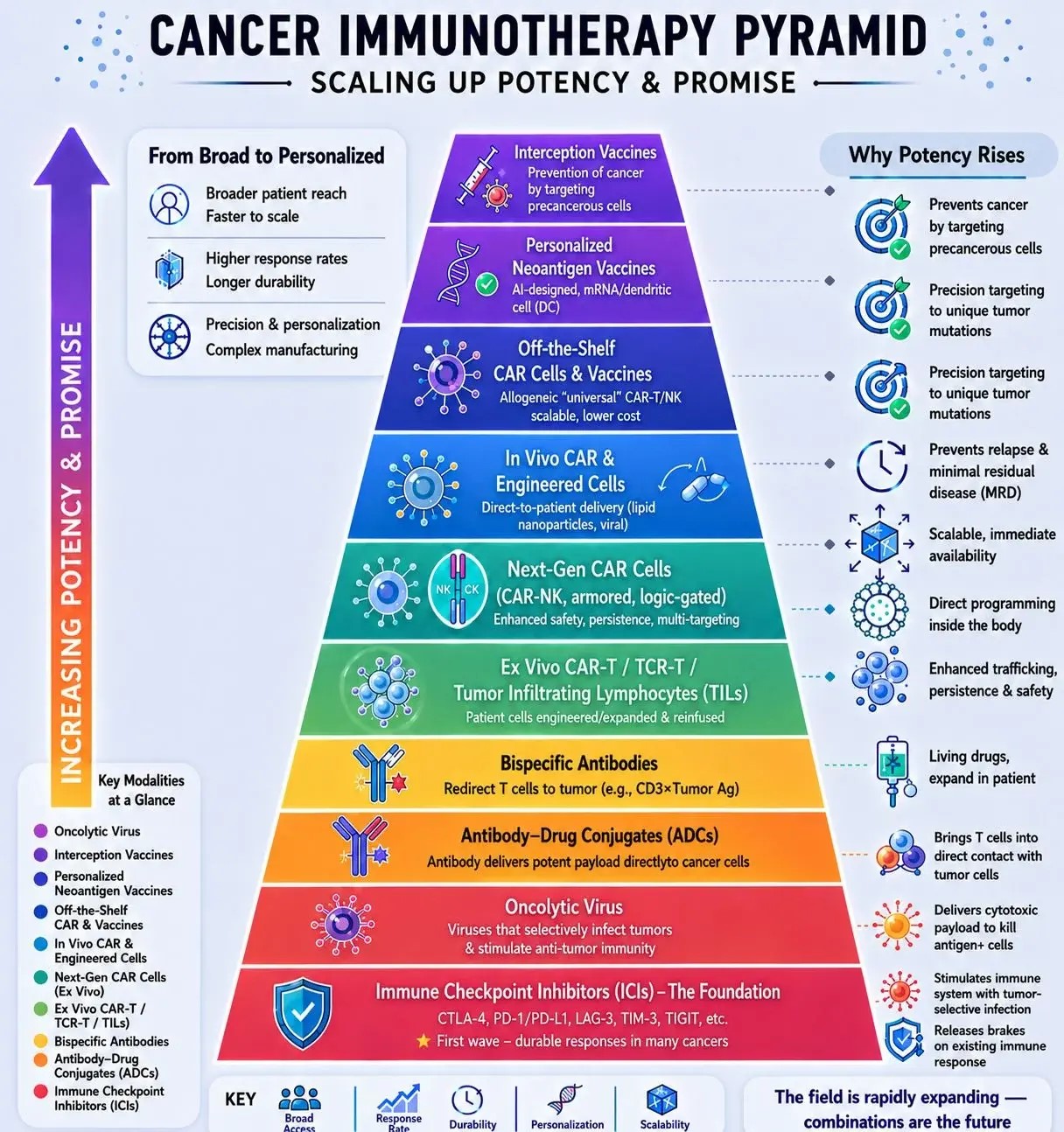
Figure: Dr. Eric Topol's Cancer Immunotherapy Pyramid
Compared
with therapeutic cancer vaccines, Professor He is more optimistic about
preventive cancer vaccines, corresponding to vaccines in the conventional
public understanding.
Renowned
medical scientist Dr. Eric Topol, Founder and Director of the Scripps Research
Translational Institute, published an immunotherapy pyramid. Immune checkpoint
inhibitors sit at the base, followed upward by oncolytic viruses, CAR‑T and other
modalities. Positioned at the very apex of the pyramid are interceptive
vaccines — preventive vaccines that intercept cancer onset.
Figure: Dr. Eric Topol's Cancer Immunotherapy
Pyramid
Professor
He concurs with this framework. "For one thing, the target population is
vastly larger: these approaches aim at cancer prevention rather than treating
established malignancy. Intervention at early preventive stages represents the
ideal clinical setting. For another, our technology has matured enough to make
this feasible."
Recent
clinical progress validates this outlook. Preventive cancer vaccines are
first being evaluated in high‑risk individuals with well‑defined
genetic predispositions who have not yet developed cancer.
Take
Lynch syndrome as an example. Patients carry germline mutations in the
MMR gene that impair DNA‑repair
function. Errors accumulate within cells, substantially elevating cancer risk.
The lifetime risk of colorectal cancer reaches 70%–80%, with disease onset
occurring significantly earlier, at a median age in the mid‑40s.
In
January 2026, investigators at MD Anderson Cancer Center published Phase Ib/II
clinical data for NOUS‑209
in Nature Medicine. This off‑the‑shelf
immunotherapeutic vaccine targets shared frameshift‑mutation neoantigens
in patients with Lynch syndrome. Forty‑five subjects were
enrolled; all mounted T‑cell
immune responses against cancer‑relevant
targets, with enhanced immune reactivity following annual booster vaccination.
After one year of treatment, reductions in precancerous lesions were observed
and no new advanced polyps emerged.
In
June of the same year, Moderna together with the University of Oxford announced
that the mRNA vaccine mRNA‑4194
for Lynch syndrome had obtained MHRA approval for a Phase I/II clinical
trial in the United Kingdom. It encodes specific neoantigens linked to early‑stage Lynch‑syndrome‑associated
carcinogenesis. Using mRNA technology, it activates the immune system and
trains T cells to recognize and eliminate precancerous cells to block cancer
initiation at source.
Beyond
Lynch‑syndrome‑related indications,
Professor He disclosed that tricision Biotherapeutics' in‑house Survivin‑targeting mRNA‑DC therapeutic cancer
vaccine has entered Phase II clinical trials and has obtained approval for
clinical application at Weiyuan Hospital within the Beidaihe Life Science &
Industry Innovation Demonstration Zone. "Survivin represents an excellent
tumor antigen, and we plan to expand its indications toward preventive vaccines
in the future."
In
Professor He's view, preventive vaccines will initially target high‑risk
populations: Lynch‑syndrome‑associated colorectal
cancer, BRCA‑mutation‑associated breast and
ovarian cancer, and lung cancer among long‑term smokers. Risk
profiles are well‑defined,
benefit‑to‑risk profiles can be
quantified, and clinical evaluation complexity is far lower than many
anticipate.
Safety
nevertheless remains an unavoidable consideration for preventive vaccines.
Professor He's stance is clear: benefit‑to‑risk
profile is paramount.
"Preventive
cancer vaccines can be considered for populations with clear clinical
indications, for example cirrhosis patients at high risk for hepatocellular
carcinoma where the benefit‑to‑risk profile is well‑established. Caution
should be exercised when administering liver‑cancer preventive
vaccines to entirely healthy individuals with normal liver function. Broad‑population deployment
of preventive cancer vaccines demands extreme prudence."
From
a technical‑evolution
perspective, Professor He notes that current mRNA‑LNP platforms belong
to the first‑generation
technology; long‑term
safety datasets remain incomplete. Multiple research groups, including his own
team, are advancing several lines of development at a rapid pace.
These
include biodegradable LNPs and highly‑targeted
LNPs capable of delivering payloads selectively to defined cell subsets such as
specific dendritic cell subpopulations.
"Targeted delivery greatly improves safety. First, required dosages
decrease, eliminating the need for high‑dose systemic
administration. Second, payloads are delivered to defined cell
populations."
Professor
He anticipates that second‑
and third‑generation
delivery technologies will enter preventive‑vaccine R&D
pipelines soon, potentially within this year and next year.
l This article
reproduces verbatim the original Chinese text published on the WeChat Official
Account "Tongxieyi" (同写意). Reprinted with
permission from Tongxieyi. The English-language content is a full translation
of the original Chinese article. The copyright of the original Chinese article
belongs to Tongxieyi.


Posts recommend
-
 Time:2026-09-20
 -
-
-