The Grim Reality of Glioblastoma Multiforme (GBM) – 90% Do Not Survive 5 Years – How Can We Rewrite the Narrative?
Glioblastoma Multiforme (GBM) is widely regarded as the "king of cancers"—a
relentless and deadly adversary of the central nervous system. In China, the
annual incidence is approximately 5–8 per 100,000 people,
accounting for more than half of all malignant brain tumors. The disease is
characterized by rapid growth, extreme malignancy, and exceptionally
low survival rates: even with standard-of-care treatment, the 5-year
survival rate remains below 10% (China Glioma Cooperative Group, 2023
data).
Current Standard Therapies Face
Significant Limitations
- Surgery: Although assisted by
neuronavigation and fluorescence guidance, with maximum safe resection
rates exceeding 70%, tumors in anatomically challenging locations or with
dense adhesions are often difficult to completely remove.
- Radiotherapy: Intensity-Modulated
Radiation Therapy (IMRT) can protect critical brain regions, but carries
risks of collateral damage and has limited efficacy in tumors that are
radioresistant.
- Chemotherapy: The standard
agent, temozolomide, faces intrinsic resistance in 50% of patients,
and is associated with significant side effects.
Emerging Therapeutic Approaches Offer
New Hope
- Tumor-Treating Fields (TTF): A
portable device that generates electric fields to disrupt cancer cell
division, with a favorable side-effect profile.
- Targeted Therapy: Agents
targeting specific drivers such as Vascular Endothelial Growth
Factor (VEGF) and BRAF have shown efficacy in
biomarker-selected patient subsets.
- Immunotherapy: Approaches that
activate the patient's own immune system against tumors, though efficacy
is variable and carries risks of immune-related adverse events.
- Messenger RNA (mRNA) Vaccines (Frontier Approach): These vaccines use mRNA encoding tumor antigens to induce
specific immunity. The successful clinical deployment of mRNA vaccines for
COVID-19, along with the Nobel Prize recognition of the underlying
technology, has provided a strong scientific and technical foundation for
this approach.
The Key to Breaking Through: The Central
Role of Cancer Vaccines
Cancer vaccines represent a core
strategy in tumor immunotherapy, designed to stimulate the body's own
immune system to precisely recognize and eliminate tumor cells. Unlike
conventional therapies, they harness the body's natural defense
mechanisms, offering advantages including fewer side effects,
potential for durable immune memory, and long-term protective effects.
tricision's Survivin-Targeting mRNA-DC
Cell Injection
Survivin is highly expressed in 95%
of malignant gliomas and helps cancer cells resist therapy.
tricision's vaccine delivers antigen-encoding mRNA into Dendritic Cells
(DCs), which are then reinfused to induce specific immune responses
mediated by CD4+ and CD8+ T cells, designed to clear residual tumor
cells after surgery.
Encouraging Clinical Data
In exploratory studies conducted at Xijing
Hospital, one patient has achieved an Overall Survival (OS) exceeding 8
years (80 months disease-free), demonstrating the remarkable potential of
this approach to significantly extend life. Reference: Combination
immunotherapy of glioblastoma with dendritic cell cancer vaccines, anti-PD-1
and poly I:C. J Pharm Anal. 2023 Jun;13(6):616-624.
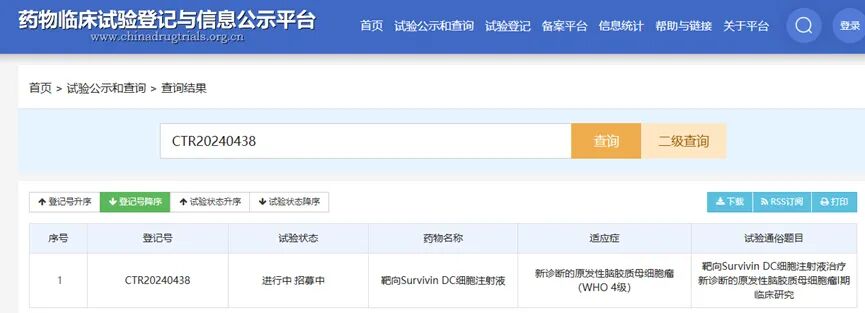
The Future is Within Reach: Beijing Tiantan Hospital is currently conducting a Phase I Clinical Trial (CT) of "Survivin-Targeting DC Cell Injection" for GBM (Clinical Trial Registration No.: CTR20240438). For inquiries, please contact: 15810449839, Manager Zhang.
About the Survivin-Targeting mRNA-DC
Tumor Vaccine
On January 10, 2023, tricision's mRNA-DC
vaccine for GBM—Survivin-Targeting DC Cell Injection—received Clinical
Trial Permission (CTP) from the National Medical Products
Administration (NMPA) (Approval No. 2023LP00065), making it the world's
first Survivin-targeting mRNA-DC therapeutic cancer vaccine to enter
clinical trials.
The therapy involves extracting a patient's
own DCs, loading them with mRNA encoding the Survivin antigen, and reinfusing
them to induce antigen-specific CD4+ and CD8+ T cell responses.
This approach is designed to eliminate residual tumor cells post-surgery,
prevent recurrence, and extend survival in primary GBM patients.
Published data confirm the vaccine's
efficacy: for glioma patients, median OS was 19 months in the
treatment group (n=5) versus 11 months in the control group
(n=28). For Small Cell Lung Cancer (SCLC) patients with brain
metastases, the respective figures were 17 months (n=5)
versus 7 months (n=13). One patient has been reported to have
an OS exceeding 60 months (5 years), with no Dose-Limiting
Toxicity (DLT) or treatment-related Adverse Events (AEs) observed
across the entire cohort.


Posts recommend
-
 Time:2026-07-10
 -
 Time:2026-07-10
 -
 Time:2026-07-10
 -