The Curious Substance from Bandages: Do You Know Life's Genetic Code?

"You reap what you sow"—why does
planting melon never yield beans? This hereditary phenomenon is determined
by genes—segments of DNA carrying genetic information, housed
within chromosomes in the cell nucleus.
In 1868, Swiss scientist Friedrich
Miescher examined pus from used bandages—rich in white blood cells—and
chemically extracted a substance containing abundant phosphorus and nitrogen.
Realizing it differed from known cellular components, he named it "nuclein" —the
first isolation of DNA. In 1889, biochemist Richard Altmann purified nucleic
acid from yeast and animal tissues, renaming it "nucleic
acid."
In 1879, German biochemist Albrecht Kossel systematically studied nuclein structure, discovering it was a protein-nucleic acid complex. He identified two nucleic acids—then called "thymus nucleic acid" and "yeast nucleic acid"—now known as DNA and RNA. Kossel received the 1910 Nobel Prize in Physiology or Medicine.
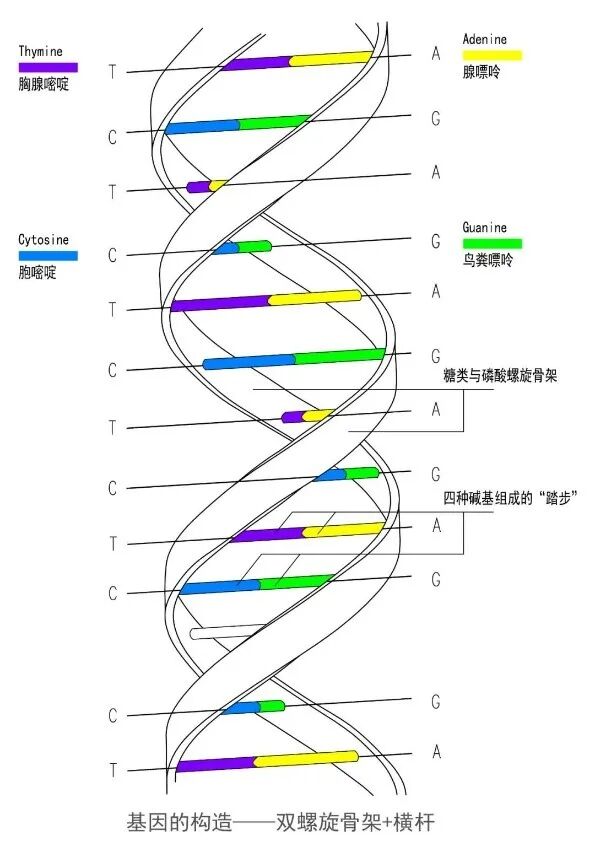
In 1953, James Watson and Francis Crick
discovered DNA's double helix structure—a twisting ladder of
sugar-phosphate backbones connected by base pairs: A (adenine) pairs
with T (thymine) , and G (guanine) pairs
with C (cytosine) . The sequence of these four bases (A, T, C,
G) constitutes the genetic code—the "book of life." Each three
adjacent bases form a codon, which is transcribed through RNA to
guide protein synthesis.
In 1977, Frederick Sanger developed the
chain-termination method—the first DNA sequencing technique—and sequenced the
first genome: bacteriophage X174 (5,375 bases). In 1990, the Human
Genome Project—the "moon landing of life sciences"—was launched.
By April 2003, it had completed sequencing of 2.9 billion base pairs of the
human genome, mapping all human genetic information and gene locations on
chromosomes.