Science: Major Breakthrough – Injectable LNP-Encapsulated mRNA Generates CAR-T Cells In Vivo, Reversing Cardiac Fibrosis
A study from the Perelman School of
Medicine at the University of Pennsylvania, published in Science on
January 7, 2022, demonstrated that an experimental immunotherapy—similar to
mRNA-based COVID-19 vaccines—can temporarily reprogram a patient's immune cells
to attack specific targets with a single injection.
The new method uses an mRNA formulation to
reprogram T cells to attack cardiac fibroblasts, which drive
heart failure by producing excessive fibrous material that stiffens the heart
muscle—a condition known as fibrosis. In mouse models of heart
failure, the reduction of cardiac fibroblasts led to significant
reversal of cardiac fibrosis.
Dr. Jonathan A. Epstein, co-corresponding author and Professor of Cardiovascular Research at Penn, stated: "Fibrosis underlies many serious diseases, including heart failure, liver disease, and kidney failure. This technology could become a scalable and affordable way to address a tremendous medical burden. The most notable advance is the ability to genetically reprogram T cells for specific clinical applications without extracting them from the patient."
The technology builds on CAR-T (Chimeric
Antigen Receptor) cell therapy, which typically requires collecting a patient's
T cells, genetically reprogramming them in the lab to recognize specific cell
surface markers, expanding them, and reinfusing them. While CAR-T has been
primarily used for cancer (approved for certain leukemias and lymphomas), the
approach has long been envisioned for other diseases.
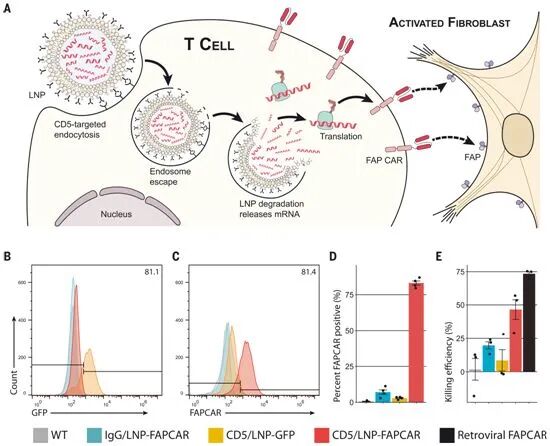
The researchers designed mRNA encoding T
cell receptors targeting activated fibroblasts and encapsulated it in lipid
nanoparticles (LNPs) coated with molecules targeting T cell surface
markers—the same mRNA technology used in COVID-19 vaccines. When injected into
mice, the LNP-encapsulated mRNA was taken up by T cells, which then transiently
produced fibroblast-targeting receptors—effectively reprogramming them to
attack activated fibroblasts. Because mRNA is not integrated into T cell DNA
and persists only a few days, the reprogramming is temporary.
Despite the transient activity, a single
injection in heart failure model mice successfully reprogrammed sufficient T
cells to substantially reduce cardiac fibrosis and restore normal heart
size and function, with no evidence of continued anti-fibrotic activity
after one week. The researchers are continuing to test this transient CAR-T
technology and hope to initiate clinical trials.