Science: First Molecular-Level Elucidation of SARS-CoV-2 Omicron Variant Cell Entry Mechanism
A study from the University of British
Columbia, published in Science on January 20, 2022, reported
the world's first molecular-level structural analysis of the Omicron spike
protein using cryo-electron microscopy (cryo-EM) at
near-atomic resolution. The study revealed how this heavily mutated variant
attaches to and infects human cells.
Dr. Sriram Subramaniam, Professor of
Biochemistry and Molecular Biology at UBC and corresponding author,
stated: "Understanding the molecular structure of the viral spike
protein is critical because it will enable us to develop more effective
treatments against Omicron and related variants. By analyzing how this virus
infects human cells, we can develop better therapies to disrupt this process
and neutralize the virus."
Omicron carries 37 mutations on its spike protein—3 to 5 times more than previous variants.
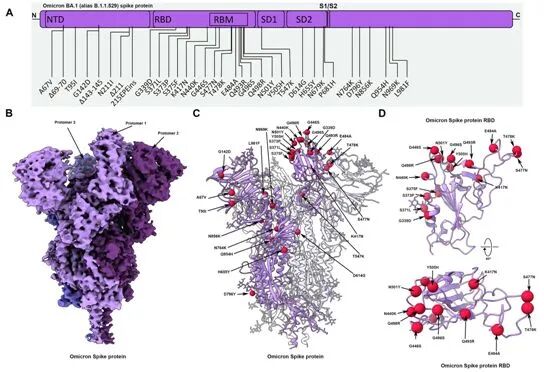
Structural analysis revealed that multiple
mutations (R493, S496, R498) create new salt bridges and hydrogen bonds between
the spike protein and the ACE2 receptor, increasing binding affinity, while
other mutations (K417N) reduce binding strength.
Dr. Subramaniam concluded: "Overall,
these findings show that Omicron has greater binding affinity than the original
SARS-CoV-2, at levels similar to Delta. It is remarkable that Omicron maintains
its ability to bind human cells despite such extensive mutations."
The study also showed that Omicron spike
protein exhibits enhanced antibody evasion—measurable evasion against all six
tested monoclonal antibodies, with complete evasion of five. The variant also
showed enhanced evasion of antibodies from vaccinated and unvaccinated COVID-19
patients. Notably, Omicron evaded vaccine-induced immunity less effectively
than natural immunity from unvaccinated patients, reinforcing vaccination as
the best defense.
The researchers concluded that the
combination of increased binding affinity and antibody evasion likely
contributes to Omicron's enhanced transmissibility. The research team will
continue to focus on understanding neutralizing antibody combinations effective
against all SARS-CoV-2 variants.